
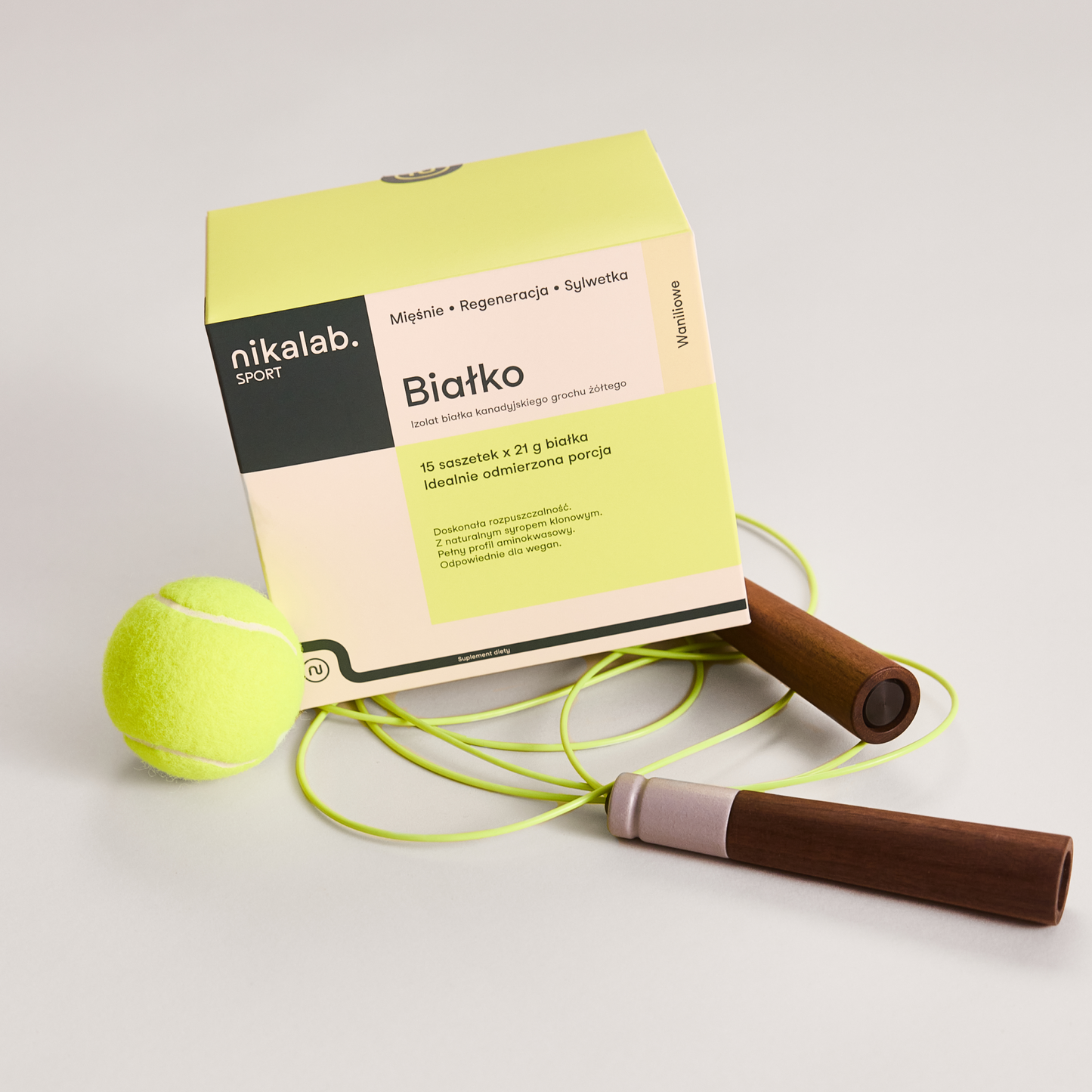
Białko waniliowe – wegańskie


Białko waniliowe – wegańskie
Odbierz rabat do 20%
Dodaj produkt do koszyka – rabat naliczy się automatycznie, zależnie od wartości zamówienia.
 Karta podarunkowa 50 zł do każdego zamówienia.
- Regular price
- 159,99 zł
- Regular price
-
- Sale price
- 159,99 zł
- Unit price
- per
Couldn't load pickup availability

Save up to 20% on every box
Free delivery on orders over PLN 150 (within Poland)
Edit or cancel whenever you want
You order once, and we deliver regularly.
Delivery PLN 15 (within Poland)



For whom?
Protein is the basic building block of muscles and tissues and plays a key role in the body - especially for people who:

PHYSICALLY ACTIVE
Scientific studies have shown that an adequate amount of protein in the diet, combined with resistance training, supports increased muscle strength and gains in lean body mass(1). Protein also contributes to the growth of muscle mass(6).

IN NEED OF RAPID RECOVERY
Research suggests that protein consumed after exercise supports muscle recovery and reduces levels of damage biomarkers, such as creatine kinase(2).

AT 55 YEARS OF AGE
Scientific research shows that an adequate amount of protein in the diet helps preserve muscle mass and strength, reducing the risk of sarcopenia and loss of physical function(4).

FOR THOSE CONCERNED ABOUT THEIR FIGURE AND BODY WEIGHT
Scientific research suggests that a higher protein intake increases satiety and supports muscle maintenance during weight loss(3). Protein also helps maintain muscle mass(7).

VEGAN AND VEGETARIAN
Research shows that people following plant-based diets and diets limiting animal products consume less protein on average than people who eat meat(5,8).
Without the right building blocks, even regular training will not deliver its full results - protein is what enables muscles to grow and recover.
A meta-analysis of 49 studies involving more than 1,800 people showed that protein supplementation during strength training leads to significantly greater gains in strength and muscle mass than a placebo(1).
For this reason, protein supplementation has become a staple in both recreational and professional sports.


MUSCLE AND STRENGTH
Without the right building blocks, even regular training will not deliver its full results - protein is what enables muscles to grow and recover.
A meta-analysis of 49 studies involving more than 1,800 people showed that protein supplementation during strength training leads to significantly greater gains in strength and muscle mass than a placebo(1).
For this reason, protein supplementation has become a staple in both recreational and professional sports.
REGENERATION
Training causes microdamage to muscle fibers, and the rebuilding process makes muscles stronger.
Scientific studies suggest that consuming protein after exercise reduces levels of muscle damage markers (such as creatine kinase) and eases post-exercise soreness, supporting faster recovery(2).
METABOLISM AND FIGURE
Muscle tissue is an important regulator of metabolism - the more of it you have, the more calories your body burns, even outside of exercise. It is estimated that each additional kilogram of muscle mass increases your basal metabolic rate by about 13 kcal per day(9).
Protein also supports weight management, partly through the so-called thermic effect of food - around 15–30% of the energy from protein is used to digest and metabolize it, compared with about 5–10% for carbohydrates and 0–3% for fats(10).
Scientific studies also suggest that a higher protein intake increases satiety - in one experiment, participants reported 60% less hunger and twice the satisfaction from meals on a high-protein diet than on a standard diet(3).

PROTEIN AND AGING
The aging process begins earlier than we think – from around age 30, we lose an average of 3-8% of muscle mass each decade, and this rate increases after age 55. This is a natural process called sarcopenia, which weakens strength and limits physical function.
Scientific studies show that getting enough protein in the diet helps older adults preserve muscle mass and strength, reducing the risk of sarcopenia and loss of independence(4).


Ingredients |
Chemical form |
Quantity (in 1 sachet) |
|---|---|---|
|
Protein (Canadian yellow pea protein isolate) |
Canadian yellow pea protein isolate | 26.25 g (including 21 g protein) |
Ingredients
Protein
Chemical form
Quantity (in 1 sachet)
Other ingredients: natural vanilla flavor (Bourbon vanilla), 100% pure Canadian maple syrup.
Recommended intake: 1 sachet daily, all at once, at any time. Drink, smoothie: mix with approx. 250 ml of water or another beverage. Best consumed immediately after preparation. Baking, oatmeal: add to batter or mix into oatmeal.
Nutritional value (100 g / 1 sachet): energy 393 kcal / 132 kcal, fat (of which saturates) 5.7 g (1.2 g) / 1.9 g (0.4 g), carbohydrates (of which sugars) 19 g (8 g) / 6.4 g (2.7 g), fiber 2 g / 0.7 g, protein 62 g / 21 g, salt 1.1 g / 0.4 g.
Storage: keep the product sealed, below 25℃, in a dry, dark place and out of reach of young children.
Warning: do not exceed the recommended dose. Dietary supplements should not be used as a substitute for a varied diet. A balanced diet and a healthy lifestyle are important for the proper functioning of the body. This product should not be used by children or pregnant women. It is also not recommended for people suffering from kidney or liver disease.
Clean ingredients.
Natural taste.
that’s for me - I’m buying it


Why pouches?
Our protein doesn’t need them – it’s 100% natural.
However, natural ingredients are sensitive to moisture and oxygen, so we seal each serving in a high-barrier compostable sachet.
It protects the protein’s taste, aroma, and quality – with no compromises and no chemicals.
Freshness. Convenience. A conscious choice.
Why
DON'T we use
sweeteners?
Read more

“Official guidelines recommend 0.8 g of protein per kilogram of body weight, but growing evidence shows that this isn’t enough. That’s why I recommend 1.2-1.6 g—a quantity that supports metabolism, helps maintain muscle and a healthy physique, and slows age-related muscle loss.”
Do you know how much protein you eat every day?
Discover our everyday bases:
Omega-3 fatty acids, vitamin D3, and other vitamins and minerals tailored to each stage of life.


Complete as needed with:


FAQ: frequently asked questions
What is a protein supplement and what are its properties?
Research shows that protein in the diet supports:
- muscle growth and maintenance(1),
- recovery after exercise by repairing microscopic damage to muscle fibers(2),
- weight management(10),
- healthy aging by protecting against muscle loss (sarcopenia)(4).
Who is protein powder intended for?
- are physically active and do strength training(1,6),
- need faster recovery(2),
- take care of their physique and body weight(3,7),
- are over 55(4),
- follow a plant-based diet or limit animal products(5,8).
How much protein does our body need each day?
Official recommendations (RDA) specify a minimum of 0.8 g of protein per kilogram of body weight per day—an amount that prevents deficiencies. However, experts suggest that the optimal intake for adults is 1.2-1.6 g/kg of body weight, and can be as high as 2.0 g/kg with intense training or weight loss.
People with kidney disease or impaired kidney function should consult a doctor before starting protein supplementation and determine the maximum safe amount of protein. This product is intended for adults.
How should Nikalab Protein be used?
When is the best time to take protein?
Can you drink a protein shake every day?
What makes Protein from nikalab stand out?
- Premium source – yellow pea protein isolate from Canada (NutriPea, a variety with high protein content and a mild flavor).
- Clean ingredients – no sweeteners, artificial colors, or flavors.
- Natural flavor – only natural Bourbon vanilla extract and 100% Canadian maple syrup.
- Excellent mixability – mixes well with water, milk, or plant-based drinks.
- No compromises – vegan, gluten-free, soy-free, non-GMO.
Is nikalab Protein suitable for people with a sensitive stomach?
Learn more about the effects of sweeteners on digestive health →
Does Nikalab Protein taste very sweet?
Why does nikalab Protein come in sachets rather than a large tub?
Our protein is natural - without these additives, so it needs better protection.
Once a large tub is opened, the powder comes into contact with moisture and oxygen, causing it to clump and lose its aroma and flavor.
That’s why every serving of nikalab is individually sealed in a sachet that protects the protein until you’re ready to use it - always fresh, always the same serving size.
The sachets are made from compostable material, so they break down like plant scraps - no plastic, no waste.
-
Morton RW, Murphy KT, McKellar SR, Schoenfeld BJ, Henselmans M, Helms E, Aragon AA, Devries MC, Banfield L, Krieger JW, Phillips SM. A systematic review, meta-analysis and meta-regression of the effect of protein supplementation on resistance training-induced gains in muscle mass and strength in healthy adults. Br J Sports Med. 2018 Mar;52(6):376-384. doi: 10.1136/bjsports-2017-097608. Epub 2017 Jul 11. Erratum in: Br J Sports Med. 2020 Oct;54(19):e7. doi: 10.1136/bjsports-2017-097608corr1. PMID: 28698222; PMCID: PMC5867436.
-
Nieman, D. C., Zwetsloot, K. A., Simonson, A. J., Hoyle, A. T., Wang, X., Nelson, H. K., Lefranc-Millot, C., & Guérin-Deremaux, L. (2020). Effects of Whey and Pea Protein Supplementation on Post-Eccentric Exercise Muscle Damage: A Randomized Trial. Nutrients, 12(8), 2382. https://doi.org/10.3390/nu12082382
-
Hudson JL, Bergia RE 3rd, Campbell WW. Effects of protein supplements consumed with meals, versus between meals, on resistance training-induced body composition changes in adults: a systematic review. Nutr Rev. 2018 Jun 1;76(6):461-468. doi: 10.1093/nutrit/nuy012. PMID: 29697807.
-
Zhang, L., Liu, G., Huang, X. et al. Effects of protein supplementation on muscle mass, muscle strength, and physical performance in older adults with physical inactivity: a systematic review and meta-analysis. BMC Geriatr 25, 228 (2025). https://doi.org/10.1186/s12877-025-05885-x
-
Rizzo NS, Jaceldo-Siegl K, Sabate J, Fraser GE. Nutrient profiles of vegetarian and nonvegetarian dietary patterns. Journal of the Academy of Nutrition and Dietetics. 2013 Dec;113(12):1610-1619. DOI: 10.1016/j.jand.2013.06.349. PMID: 23988511; PMCID: PMC4081456.
-
European Commission. Protein contributes to the growth of muscle mass. EU Register on Nutrition and Health Claims. [HC-6446]
-
European Commission. Protein helps maintain muscle mass. EU Register on Nutrition and Health Claims. [HC-6447]
-
Clarys, P., Deliens, T., Huybrechts, I., Deriemaeker, P., Vanaelst, B., De Keyzer, W., Hebbelinck, M., & Mullie, P. (2014). Comparison of Nutritional Quality of the Vegan, Vegetarian, Semi-Vegetarian, Pesco-Vegetarian and Omnivorous Diet. Nutrients, 6(3), 1318-1332. https://doi.org/10.3390/nu6031318
-
Rolfe DF, Brown GC. Cellular energy utilization and molecular origin of standard metabolic rate in mammals. Physiol Rev. 1997;77(3):731–758. doi:10.1152/physrev.1997.77.3.731
-
Westerterp, K.R. Diet-induced thermogenesis. Nutr Metab (Lond) 1, 5 (2004). https://doi.org/10.1186/1743-7075-1-5
-
U.S. International Trade Commission. (2023, September). Certain pea protein from China: Investigation Nos. 701-TA-692 and 731-TA-1628 (Preliminary) (USITC Publication 5457). Washington, DC: U.S. International Trade Commission