
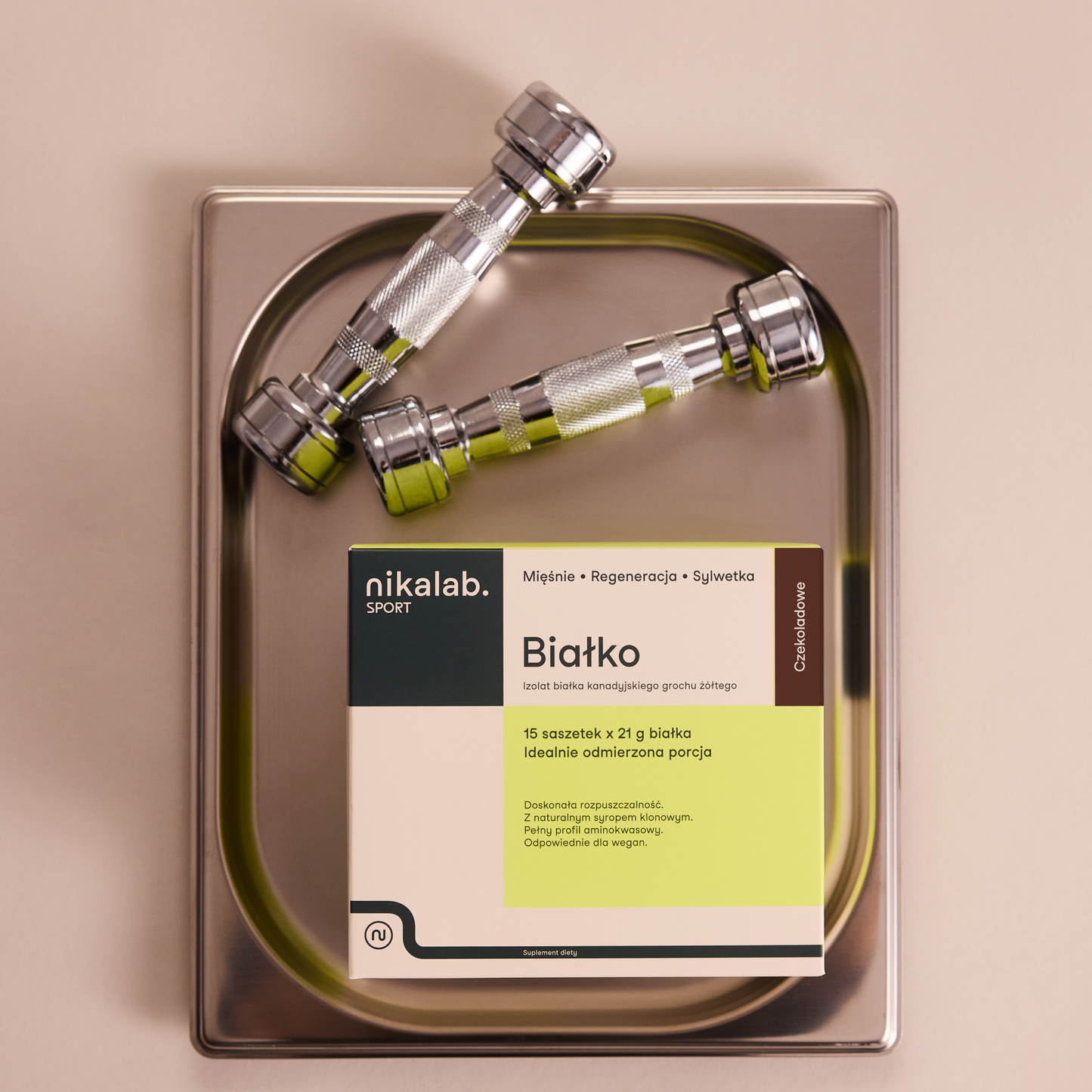
Vegan chocolate protein powder


Vegan chocolate protein powder
Wybierz smak:
- Regular price
- 159,99 zł
- Regular price
-
- Sale price
- 159,99 zł
- Unit price
- per
Couldn't load pickup availability

Oszczędzasz do 20% na każdym pudełku
Darmowa dostawa od 150 zł (na terenie Polski)
Edytujesz lub rezygnujesz kiedy chcesz
Zamawiasz raz, a my dostarczamy regularnie
Dostawa 15 zł (na terenie Polski)



Dla kogo?
Białko to podstawowy budulec mięśni i tkanek, który odgrywa kluczową rolę w organizmie – szczególnie u osób:

AKTYWNYCH FIZYCZNIE
Badania naukowe pokazały, że odpowiednia ilość białka w diecie w połączeniu z treningiem oporowym, wspiera zwiększenie siły mięśni i wzrost beztłuszczowej masy ciała(1). Białko przyczynia się także do wzrostu masy mięśniowej(6).

POTRZEBUJĄCYCH SZYBKIEJ REGENERACJI
Badania naukowe sugerują, że białko spożyte po wysiłku wspiera odbudowę mięśni i zmniejsza poziom biomarkerów uszkodzeń, takich jak kinaza kreatynowa(2).

PO 55. ROKU ŻYCIA
Badania naukowe pokazują, że odpowiednia ilość białka w diecie wspiera zachowanie masy mięśniowej i siły, zmniejszając ryzyko sarkopenii i utraty sprawności(4).

DBAJĄCYCH O SYLWETKĘ I MASĘ CIAŁA
Badania naukowe sugerują, że wyższa podaż białka zwiększa sytość i wspiera utrzymanie mięśni podczas redukcji(3). Białko pomaga również w utrzymaniu masy mięśniowej(7).

WEGAN I WEGETARIAN
Badania naukowe pokazują, że osoby na diecie roślinnej oraz ograniczającej produkty odzwierzęce spożywają średnio mniej białka niż osoby jedzące mięso(5,8).
Bez odpowiedniego budulca nawet regularny trening nie przyniesie pełnych rezultatów – to właśnie białko daje mięśniom możliwość wzrostu i regeneracji.
Meta-analiza 49 badań z udziałem ponad 1800 osób pokazała, że suplementacja białkiem podczas treningu siłowego prowadzi do wyraźnie większych przyrostów siły i masy mięśniowej niż placebo(1).
Z tego powodu suplementacja białkiem stała się podstawą zarówno w sporcie rekreacyjnym, jak i zawodowym.


MIĘŚNIE I SIŁA
Bez odpowiedniego budulca nawet regularny trening nie przyniesie pełnych rezultatów – to właśnie białko daje mięśniom możliwość wzrostu i regeneracji.
Meta-analiza 49 badań z udziałem ponad 1800 osób pokazała, że suplementacja białkiem podczas treningu siłowego prowadzi do wyraźnie większych przyrostów siły i masy mięśniowej niż placebo(1).
Z tego powodu suplementacja białkiem stała się podstawą zarówno w sporcie rekreacyjnym, jak i zawodowym.
REGENERACJA
Trening oznacza mikrouszkodzenia włókien mięśniowych, a proces ich odbudowy sprawia, że mięśnie stają się silniejsze.
Badania naukowe sugerują, że spożycie białka po wysiłku zmniejsza poziom markerów uszkodzeń mięśni (takich jak kinaza kreatynowa) i łagodzi powysiłkową bolesność, wspierając szybszą regenerację(2).
METABOLIZM I SYLWETKA
Tkanka mięśniowa to ważny regulator metabolizmu – im jest jej więcej, tym intensywniej organizm spala kalorie także poza treningiem. Szacuje się, że każdy dodatkowy kilogram masy mięśniowej zwiększa podstawową przemianę materii o ok. 13 kcal dziennie(9).
Białko wspiera też kontrolę masy ciała m.in. dzięki tzw. efektowi termicznemu pożywienia - około 15–30% energii z białka jest zużywane na jego trawienie i metabolizm, podczas gdy dla węglowodanów jest to ok. 5–10%, a dla tłuszczów 0–3%(10).
Badania naukowe sugerują również, że wyższa podaż białka zwiększa sytość – w jednym z eksperymentów uczestnicy zgłaszali 60% mniejszy głód i dwukrotnie większą satysfakcję z posiłków na diecie wysokobiałkowej niż na standardowej(3).

BIAŁKO A STARZENIE
Proces starzenia zaczyna się wcześniej, niż nam się wydaje – od około 30. roku życia tracimy średnio 3-8% masy mięśniowej w każdej dekadzie, a tempo tego zjawiska rośnie po 55. roku życia. To naturalny proces nazywany sarkopenią, który osłabia siłę i ogranicza sprawność.
Badania naukowe pokazują, że odpowiednia ilość białka w diecie wspiera zachowanie masy i siły mięśniowej u osób starszych, zmniejszając ryzyko sarkopenii i utraty niezależności(4).


Składniki |
Forma chemiczna |
Ilość (w 1 saszetce) |
|---|---|---|
|
Białko (Izolat białka kanadyjskiego grochu żółtego) |
Izolat białka kanadyjskiego grochu żółtego | 26,25 g (w tym białko 21 g) |
Składniki
Białko
Forma chemiczna
Ilość (w 1 saszetce)
Pozostałe składniki: 100% organiczne ziarna kakao, 100% czysty kanadyjski syrop klonowy.
Zalecane spożycie: 1 saszetka dziennie, na raz, o dowolnej porze. Napój, koktajl: wymieszaj w ok. 250 ml wody lub innego napoju. Najlepiej wypij bezpośrednio po przygotowaniu. Wypieki, owsianka: dodaj do ciasta na wypieki lub wymieszaj z owsianką.
Wartość odżywcza (100 g / 1 saszetka): wartość energetyczna 385 kcal / 130 kcal, tłuszcze (w tym nasycone) 7,1 g (2,2 g) / 2,4 g (0,7 g), węglowodany (w tym cukry) 10,9 g (7,5 g) / 3,7 g (2,5 g), błonnik 6,2 g / 2,1 g, białko 65 g / 22 g, sól 1,1 g / 0,4 g.
Przechowywanie: produkt przechowuj zamknięty, w temp. poniżej 25℃, w suchym i ciemnym miejscu oraz w sposób niedostępny dla małych dzieci.
Ostrzeżenie: nie przekraczaj zalecanej dawki. Suplementy diety nie powinny być stosowane jako substytut zróżnicowanej diety. Zrównoważony sposób żywienia oraz prowadzenie zdrowego trybu życia są ważne dla prawidłowego funkcjonowania organizmu. Produkt nie powinien być stosowany przez dzieci i kobiety w ciąży. Nie zaleca się go także osobom cierpiącym na choroby nerek lub wątroby.
Czysty skład.
Naturalny smak.
to dla mnie – kupuję


Dlaczego saszetki?
Nasze białko tego nie potrzebuje – jest w 100% naturalne.
Naturalne składniki są jednak wrażliwe na wilgoć i tlen, dlatego każdą porcję zamykamy w kompostowalnej saszetce o wysokiej barierowości.
Chroni ona smak, zapach i jakość białka – bez kompromisów i bez chemii.
Świeżość. Wygoda. Świadomy wybór.
Dlaczego
NIE używamy
słodzików?
czytaj więcej

„Oficjalne normy mówią o 0,8 g białka na kilogram masy ciała, ale coraz więcej dowodów pokazuje, że to za mało. Dlatego rekomenduję 1,2-1,6 g – ilość, która wspiera metabolizm, pomaga utrzymać mięśnie i zdrową sylwetkę oraz spowalnia spadek masy mięśniowej wraz z wiekiem.”
Czy wiesz, ile białka zjadasz na co dzień?
Poznaj nasze Bazy na co dzień:
kwasy Omega-3, witamina D3 oraz inne witaminy i minerały, dopasowane do etapu życia.


Uzupełnij w zależności od potrzeb o:


FAQ: najczęściej zadawane pytania
Czym jest odżywka białkowa i jakie ma właściwości?
Jak pokazują badania, białko w diecie wspiera:
- wzrost i utrzymanie masy mięśniowej(1),
- regenerację po wysiłku dzięki odbudowie mikrouszkodzeń włókien(2),
- kontrolę masy ciała(10),
- zdrowe starzenie się, chroniąc przed utratą mięśni (sarkopenią)(4).
Dla kogo przeznaczona jest odżywka białkowa?
- aktywnym fizycznie i trenującym siłowo(1,6),
- potrzebującym szybszej regeneracji(2),
- dbającym o sylwetkę i masę ciała(3,7),
- po 55. roku życia(4),
- na diecie roślinnej lub ograniczającej produkty zwierzęce(5,8).
Ile białka dziennie potrzebuje nasz organizm?
Oficjalne normy (RDA) wskazują minimum 0,8 g białka na kilogram masy ciała dziennie – to ilość zapobiegająca niedoborom. Eksperci sugerują jednak, że optymalna podaż dla osób dorosłych to 1,2-1,6 g/kg masy ciała, a przy intensywnych treningach czy redukcji masy ciała nawet do 2,0 g/kg.
Osoby cierpiące na choroby nerek lub zaburzenia pracy nerek przed rozpoczęciem suplementacji białkiem powinny skonsultować się z lekarzem w tym ustalić maksymalną dopuszczalną ilość białka. Produkt jest przeznaczony dla osób dorosłych.
Jak należy stosować Białko od nikalab?
Kiedy najlepiej przyjmować białko?
Czy można pić odżywkę białkową codziennie?
Czym wyróżnia się Białko od nikalab?
- Źródło premium – izolat białka żółtego grochu z Kanady (NutriPea, odmiana o wysokiej zawartości białka i łagodnym smaku).
- Czysty skład – bez słodzików, sztucznych barwników i aromatów.
- Naturalny smak – 100% organiczne ziarna kakao i 100% syrop klonowy z Kanady.
- Świetna rozpuszczalność – dobrze miesza się z wodą i mlekiem, czy napojami roślinnymi.
- Bez kompromisów – produkt wegański, bez glutenu, bez soi, non-GMO.
Czy Białko od nikalab jest odpowiednie dla osób z wrażliwym żołądkiem?
Dowiedz się więcej o wpływie słodzików na zdrowie układu pokarmowego →
Czy Białko nikalab jest bardzo słodkie w smaku?
Dlaczego Białko od nikalab jest w saszetkach, a nie w dużej puszce?
Nasze białko jest naturalne – bez takich dodatków, więc wymaga lepszej ochrony.
Po otwarciu dużej puszki proszek ma kontakt z wilgocią i tlenem, przez co zaczyna się zbrylać, tracić zapach i smak.
Dlatego każda porcja nikalab jest zamknięta osobno w saszetce, która chroni białko aż do momentu użycia – zawsze świeże, zawsze w tej samej dawce.
Saszetki są wykonane z materiału kompostowalnego, czyli rozkładają się jak resztki roślin – bez plastiku, bez śmieci.
-
Morton RW, Murphy KT, McKellar SR, Schoenfeld BJ, Henselmans M, Helms E, Aragon AA, Devries MC, Banfield L, Krieger JW, Phillips SM. A systematic review, meta-analysis and meta-regression of the effect of protein supplementation on resistance training-induced gains in muscle mass and strength in healthy adults. Br J Sports Med. 2018 Mar;52(6):376-384. doi: 10.1136/bjsports-2017-097608. Epub 2017 Jul 11. Erratum in: Br J Sports Med. 2020 Oct;54(19):e7. doi: 10.1136/bjsports-2017-097608corr1. PMID: 28698222; PMCID: PMC5867436.
-
Nieman, D. C., Zwetsloot, K. A., Simonson, A. J., Hoyle, A. T., Wang, X., Nelson, H. K., Lefranc-Millot, C., & Guérin-Deremaux, L. (2020). Effects of Whey and Pea Protein Supplementation on Post-Eccentric Exercise Muscle Damage: A Randomized Trial. Nutrients, 12(8), 2382. https://doi.org/10.3390/nu12082382
-
Hudson JL, Bergia RE 3rd, Campbell WW. Effects of protein supplements consumed with meals, versus between meals, on resistance training-induced body composition changes in adults: a systematic review. Nutr Rev. 2018 Jun 1;76(6):461-468. doi: 10.1093/nutrit/nuy012. PMID: 29697807.
-
Zhang, L., Liu, G., Huang, X. et al. Effects of protein supplementation on muscle mass, muscle strength, and physical performance in older adults with physical inactivity: a systematic review and meta-analysis. BMC Geriatr 25, 228 (2025). https://doi.org/10.1186/s12877-025-05885-x
-
Rizzo NS, Jaceldo-Siegl K, Sabate J, Fraser GE. Nutrient profiles of vegetarian and nonvegetarian dietary patterns. Journal of the Academy of Nutrition and Dietetics. 2013 Dec;113(12):1610-1619. DOI: 10.1016/j.jand.2013.06.349. PMID: 23988511; PMCID: PMC4081456.
-
European Commission. Białko przyczynia się do wzrostu masy mięśniowej. EU Register on Nutrition and Health Claims. [HC-6446]
-
European Commission. Białko pomaga w utrzymaniu masy mięśniowej. EU Register on Nutrition and Health Claims. [HC-6447]
-
Clarys, P., Deliens, T., Huybrechts, I., Deriemaeker, P., Vanaelst, B., De Keyzer, W., Hebbelinck, M., & Mullie, P. (2014). Comparison of Nutritional Quality of the Vegan, Vegetarian, Semi-Vegetarian, Pesco-Vegetarian and Omnivorous Diet. Nutrients, 6(3), 1318-1332. https://doi.org/10.3390/nu6031318
-
Rolfe DF, Brown GC. Cellular energy utilization and molecular origin of standard metabolic rate in mammals. Physiol Rev. 1997;77(3):731–758. doi:10.1152/physrev.1997.77.3.731
-
Westerterp, K.R. Diet induced thermogenesis. Nutr Metab (Lond) 1, 5 (2004). https://doi.org/10.1186/1743-7075-1-5
-
U.S. International Trade Commission. (2023, September). Certain pea protein from China: Investigation Nos. 701-TA-692 and 731-TA-1628 (Preliminary) (USITC Publication 5457). Washington, DC: U.S. International Trade Commission